In the fast-paced world of digital marketing, where attention spans are shorter than ever, Facebook Ads emerge as a game-changer for businesses aiming to connect with billions of potential customers. Picture this: a small coffee shop in a bustling city transforms its quiet afternoons into peak hours by targeting local caffeine enthusiasts with irresistible offers right in their social feeds. This isn’t just a dream—it’s the reality powered by Facebook Ads, a sophisticated advertising platform that leverages user data to deliver personalized promotions across Facebook, Instagram, Messenger, and beyond. As we step into 2026, with over 3.07 billion monthly active users on Facebook alone, understanding these ads isn’t optional; it’s essential for any business looking to thrive online. This in-depth article explores everything from the basics of Facebook Ads to advanced strategies, helping you navigate this powerful tool with confidence. Whether you’re a novice entrepreneur or a marketing pro, you’ll gain insights into creating, targeting, and optimizing ads that drive real results. We’ll cover key concepts, share success stories, and provide actionable tips to boost your ROI. Plus, with Pinterest-friendly visuals like infographics and example screenshots scattered throughout, you can easily pin and share your favorite takeaways for later reference.
Understanding the Fundamentals of Facebook Ads
Facebook Ads represent paid promotional content strategically placed within the Meta ecosystem, allowing businesses to reach specific audiences with tailored messages. Unlike organic posts that rely on algorithms for visibility, these ads guarantee exposure through a bidding system, ensuring your content appears in users’ news feeds, stories, or even external apps. Since their inception in 2007, Facebook Ads have evolved dramatically, incorporating AI-driven features that predict user behavior and optimize delivery in real-time. Today, they integrate seamlessly with Instagram and Messenger, expanding reach to over 2.11 billion daily active users who engage with the platform multiple times a day. This vast user base makes Facebook Ads indispensable for brands seeking measurable growth.
The appeal of Facebook Ads lies in their precision and affordability, but they come with challenges that savvy marketers must navigate. For instance, ad fatigue can occur when users see the same creative too often, leading to decreased engagement. Privacy regulations, like those from Apple’s iOS updates, have also impacted tracking capabilities, forcing advertisers to adapt with creative solutions. Despite these hurdles, the platform’s ad revenue surged to impressive heights, with Meta reporting $42.31 billion in Q1 2025 alone, highlighting its enduring effectiveness. Businesses of all sizes benefit from this, as even small budgets can yield significant returns when managed well.
To grasp why Facebook Ads dominate digital marketing, consider their pros and cons in detail. Pros include hyper-targeted audiences based on demographics, interests, and behaviors, making campaigns highly efficient. They’re also cost-effective, with average costs per click hovering around $1.13 globally in 2025, allowing startups to compete with giants. On the flip side, cons like intense competition can drive up bids, and strict ad policies may reject non-compliant creatives, requiring constant vigilance.
- Pros: Precise targeting options, scalable budgeting, real-time analytics for optimization.
- Cons: Potential for ad rejection due to policy violations, user privacy concerns limiting data access, risk of overspending without proper monitoring.
How Facebook Ads Work: From Creation to Delivery
At the heart of Facebook Ads is a sophisticated auction system where ads vie for placement based on factors like bid amount, ad quality, and relevance to the user. When you create an ad, it enters this auction every time a spot becomes available in a user’s feed, with the highest-value ad winning the slot. The Facebook Pixel, a snippet of code installed on your website, plays a crucial role by tracking user actions like views or purchases, enabling retargeting and performance measurement. This data loop ensures ads are delivered to those most likely to convert, maximizing efficiency in a crowded digital space.
The ad review process is another critical step, where Facebook’s algorithms and human moderators check for compliance with community standards and advertising policies. Ads promoting prohibited items like tobacco or misleading claims are swiftly rejected, emphasizing the need for ethical marketing. Once approved, ads are optimized using machine learning, which adjusts delivery based on performance metrics. In 2025, the average click-through rate (CTR) for Facebook Ads stood at approximately 0.90-1.10%, underscoring the importance of compelling creatives to stand out.
Creating effective Facebook Ads follows a structured process that anyone can master with practice. Start by defining clear objectives, such as increasing brand awareness or driving website traffic, to guide your campaign setup. Next, audience selection refines who sees your ads, using tools like custom audiences from your email lists. Budgeting comes into play here, with options for daily or lifetime spends to control costs.
- Set objectives: Choose from awareness, consideration, or conversion goals to align with business needs.
- Define audience: Layer demographics, interests, and behaviors for pinpoint accuracy.
- Choose ad format and placement: Select from images, videos, or carousels, and decide on automatic or manual placements.
- Set budget and schedule: Allocate funds and timing to match peak user activity.
- Monitor and optimize: Use Ads Manager to tweak underperforming elements based on data.
You must Read: 7 Proven Digital Marketing Strategies to Grow Your Business in 2026
Types of Facebook Ads and When to Use Them
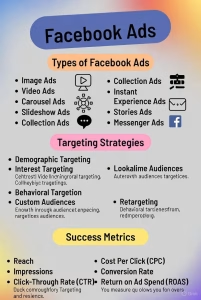
Facebook Ads come in diverse formats, each designed to cater to different marketing goals and audience preferences. Image ads, for example, are straightforward and quick to produce, featuring a single visual with overlay text for instant impact. They’re ideal for brand awareness campaigns where simplicity drives clicks. Video ads, on the other hand, captivate with motion and sound, boasting engagement rates up to 5 times higher than static formats, making them perfect for storytelling or product demos. Carousel ads allow showcasing multiple products in a swipeable format, boosting traffic by 30-50% in e-commerce scenarios.
Lead ads streamline form submissions directly within the platform, reducing friction for sign-ups or inquiries, which is invaluable for service-based businesses. Collection ads combine images or videos with a product catalog, creating an immersive shopping experience that encourages immediate purchases. Each type shines in specific contexts: use image ads for quick promotions, videos for emotional connections, and carousels for variety.
- Image Ads: Simple visuals with text; pros include fast creation and low production costs; cons are limited storytelling; example: A restaurant promoting daily specials.
- Video Ads: Dynamic content; pros feature high engagement (0.50% CTR baseline); cons require more editing time; example: A fitness brand sharing workout tips.
- Carousel Ads: Multi-slide displays; pros allow product comparisons; cons can overwhelm if overused; example: Fashion retailer highlighting seasonal collections.
Targeting Strategies in Facebook Ads for Maximum Reach
Effective targeting is the secret sauce of successful Facebook Ads, enabling businesses to reach the right people at the right time. Core targeting options include demographics like age and location, combined with interests such as hobbies or favorite brands, to create detailed profiles. Custom audiences take this further by uploading your own data, like past customers, for retargeting warm leads. Lookalike audiences expand reach by finding users similar to your best customers, often yielding 2.5 times higher ROI.
Advanced strategies incorporate life events, such as engagements or moves, to time ads perfectly. Post-iOS 14 privacy changes have shifted focus to first-party data, but tools like the Conversions API help maintain accuracy. Common pitfalls include over-narrowing audiences, which limits scale, so start broad and refine based on performance.
- Start broad, then refine: Test large groups before honing in on high-performers.
- Use A/B testing for audiences: Compare variations to identify winners.
- Leverage retargeting for cart abandoners: Remind users of incomplete purchases to recover sales.
Measuring Success: Facebook Ads Metrics and Analytics
Tracking Facebook Ads performance hinges on key metrics that reveal campaign health and areas for improvement. Impressions count how often your ad is displayed, while reach indicates unique viewers, helping gauge visibility. Engagement metrics, like likes and shares, show interaction levels, with video ads often leading at higher rates. Conversions track desired actions, such as sales, powered by the Pixel for accurate attribution.
In Ads Manager, dashboards provide real-time insights, integrating with tools like Google Analytics for holistic views. Benchmarks for 2025 show an average ROAS of 4:1 in e-commerce, guiding expectations. Attribution models, like last-click or multi-touch, assign credit to touchpoints, refining future strategies.
- Impressions: Times ad shown; aim high but monitor frequency to avoid fatigue.
- CTR: Clicks/impressions; average 1-2%, higher signals strong appeal.
- Conversions: Key actions; optimize with A/B tests for better rates.
Best Practices and Common Mistakes in Facebook Ads
Mastering Facebook Ads requires adhering to best practices that enhance engagement and efficiency. Craft compelling copy that’s concise and benefit-focused, paired with high-quality visuals optimized for mobile viewing. A/B testing multiple variations uncovers what resonates, with studies showing 30% performance lifts. Monitor frequency to prevent burnout, and always comply with policies to avoid bans.
Common mistakes include ignoring audience feedback, leading to irrelevant ads, or over-targeting, which shrinks potential reach. Neglecting mobile optimization misses the majority of users, as most interactions occur on phones.
- Use eye-catching visuals and short copy: Grab attention in seconds.
- Test multiple variations: Iterate based on data.
- Monitor frequency: Refresh creatives regularly.
Real-World Facebook Ads Success Stories
Real brands demonstrate the power of Facebook Ads through tangible results. For instance, boohooMAN, a fashion retailer, used targeted video ads to grow their audience, achieving significant sales uplifts by focusing on young demographics. Another example is a small e-commerce brand that leveraged carousel ads and lookalikes, tripling sales in months. Non-profits have also succeeded, like those using lead ads for fundraising, boosting donations by 200%.
- Case 1: E-commerce brand – Targeted lookalikes, 3x sales uplift; key takeaway: Data-driven expansion.
- Case 2: Service business – Video ads, 50% cost reduction; lesson: Storytelling drives efficiency.
Getting Started with Facebook Ads Today
Facebook Ads offer unparalleled opportunities for business growth, blending precision targeting with measurable outcomes to deliver impressive ROI. From understanding basics to mastering metrics, this guide equips you with the knowledge to launch effective campaigns. Don’t wait—sign up for Ads Manager, start with a small budget, and experiment to see results. Engage in the comments below with your ad experiences, or share this article on Pinterest for more marketing tips