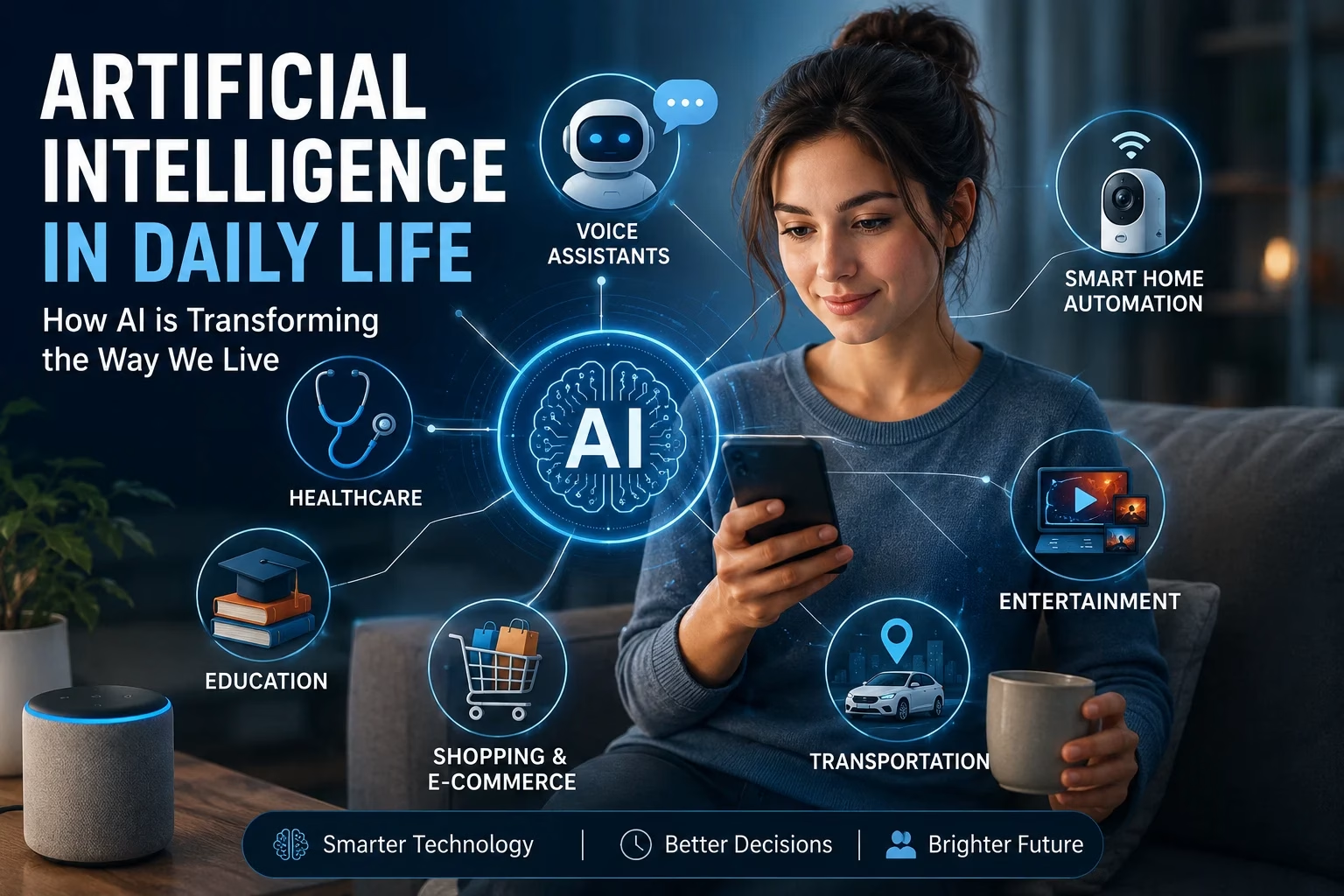
Artificial Intelligence (AI) is no longer a futuristic concept seen only in movies and science fiction. Today, Artificial Intelligence in Daily Life has become an essential part of modern living, helping people perform tasks more efficiently and conveniently. From voice assistants and smart home devices to online shopping recommendations and healthcare applications, AI is influencing almost every aspect of our daily routines.
As technology continues to evolve, the role of Artificial Intelligence in Daily Life is expanding rapidly. Businesses, educational institutions, healthcare providers, and individuals are benefiting from AI-powered solutions that save time, improve productivity, and enhance decision-making. This article explores how AI impacts everyday life, its benefits, challenges, and future possibilities.
Understanding Artificial Intelligence
Artificial Intelligence refers to the simulation of human intelligence in machines that are programmed to think, learn, and solve problems. AI systems can analyze data, recognize patterns, make decisions, and continuously improve their performance through machine learning.
Key Components of AI
Machine Learning
Machine Learning enables systems to learn from data and improve without explicit programming. It is widely used in recommendation systems, fraud detection, and predictive analytics.
Natural Language Processing
Natural Language Processing (NLP) helps machines understand and respond to human language. Virtual assistants and chatbots rely heavily on NLP technology.
Computer Vision
Computer Vision allows machines to interpret and analyze visual information such as images and videos. This technology is used in facial recognition and autonomous vehicles.
You Must Read:
Artificial Intelligence in Daily Life Applications
Artificial Intelligence has become deeply integrated into everyday activities. Many people interact with AI multiple times a day without even realizing it.
Smart Assistants and Voice Technology
Virtual assistants such as Siri, Google Assistant, and Alexa use AI to understand voice commands and perform tasks. These assistants can set reminders, play music, answer questions, and control smart home devices.
The growing use of smart assistants demonstrates how Artificial Intelligence in Daily Life simplifies routine activities and improves convenience.
Smart Home Automation
AI-powered smart homes allow users to control lighting, temperature, security systems, and appliances remotely. Smart thermostats can learn user preferences and automatically adjust settings to optimize comfort and energy efficiency.
Benefits of Smart Homes
- Reduced energy consumption
- Enhanced security
- Increased convenience
- Improved home management
AI in Healthcare
Healthcare is one of the sectors experiencing significant transformation through AI technology.
Improved Diagnosis
AI systems can analyze medical images and patient data to assist doctors in identifying diseases more accurately and quickly.
Personalized Treatment Plans
Artificial Intelligence in Daily Life is helping healthcare providers create customized treatment plans based on a patient’s medical history, lifestyle, and genetic information.
Remote Health Monitoring
Wearable devices powered by AI can monitor heart rate, sleep patterns, and physical activity, allowing users to track their health in real time.
You must Read: What Is Facebook Ads?
AI in Education
Education has become more personalized and accessible through AI-powered tools.
Personalized Learning Experiences
AI systems can assess student performance and adapt learning materials to individual needs, helping students learn at their own pace.
Virtual Tutors
AI-based tutoring platforms provide instant assistance, answer questions, and offer personalized recommendations to improve learning outcomes.
Benefits for Students
- Flexible learning schedules
- Customized study plans
- Immediate feedback
- Enhanced engagement
The impact of Artificial Intelligence in Daily Life is particularly evident in online education, where learners can access resources anytime and anywhere.
AI in Shopping and E-Commerce
Online shopping experiences have improved significantly thanks to AI technology.
Personalized Recommendations
E-commerce platforms use AI algorithms to analyze customer behavior and recommend products based on browsing and purchase history.
Customer Support Chatbots
AI-powered chatbots provide instant customer service, answer questions, and assist with purchases 24/7.
Fraud Detection
AI helps identify suspicious transactions and protect customers from online fraud.
These innovations show how Artificial Intelligence in Daily Life enhances both customer satisfaction and business efficiency.
You must Read: 7 Proven Digital Marketing Strategies to Grow Your Business
AI in Transportation
Transportation systems are becoming smarter and more efficient through AI.
Navigation and Traffic Management
GPS applications use AI to analyze traffic conditions and suggest the fastest routes.
Autonomous Vehicles
Self-driving vehicles rely on AI technologies such as computer vision and machine learning to navigate roads safely.
Improved Public Transportation
AI can optimize routes, reduce delays, and improve passenger experiences through predictive maintenance and real-time scheduling.
AI in Entertainment
Entertainment platforms use AI to provide personalized experiences for users.
Content Recommendations
Streaming services recommend movies, music, and shows based on user preferences and viewing habits.
Gaming Enhancements
AI improves gaming experiences by creating intelligent opponents and adaptive gameplay environments.
As a result, Artificial Intelligence in Daily Life makes entertainment more engaging and customized.
Benefits of Artificial Intelligence in Daily Life
AI offers numerous advantages that improve efficiency and convenience.
Increased Productivity
AI automates repetitive tasks, allowing people to focus on more important activities.
Better Decision-Making
AI systems analyze large amounts of data and provide insights that help individuals and businesses make informed decisions.
Enhanced Accessibility
AI-powered tools assist people with disabilities through voice recognition, text-to-speech features, and smart accessibility solutions.
Time Savings
Automation reduces the time required to complete everyday tasks, increasing overall efficiency.
Challenges and Concerns
Despite its benefits, Artificial Intelligence in Daily Life also presents certain challenges.
Privacy Issues
Many AI systems collect large amounts of personal data, raising concerns about privacy and data security.
Job Displacement
Automation may replace certain jobs, requiring workers to develop new skills and adapt to changing workplace demands.
Ethical Considerations
AI decision-making processes can sometimes lead to bias if systems are trained using incomplete or unbalanced data.
Addressing these challenges is essential to ensure responsible AI development and implementation.
The Future of Artificial Intelligence in Daily Life
The future of AI promises even greater innovation and integration into everyday activities. Emerging technologies such as advanced robotics, smart cities, autonomous transportation, and intelligent healthcare systems will continue to transform society.
As AI becomes more sophisticated, people can expect enhanced personalization, improved efficiency, and smarter solutions to complex problems. Governments, businesses, and technology developers must work together to ensure AI is used ethically and responsibly.
Frequently Asked Questions (FAQ)
What is Artificial Intelligence in Daily Life?
Artificial Intelligence in Daily Life refers to the use of AI-powered technologies and systems that help people perform everyday tasks more efficiently. Examples include voice assistants, smart home devices, recommendation systems, and navigation apps.
How does AI improve daily life?
AI improves daily life by automating repetitive tasks, providing personalized recommendations, enhancing convenience, saving time, and helping users make better decisions through data analysis.
What are some common examples of AI in everyday life?
Common examples include virtual assistants like Siri and Alexa, Google Maps navigation, Netflix recommendations, online shopping suggestions, smart home devices, facial recognition systems, and AI-powered chatbots.
Is Artificial Intelligence safe to use?
Artificial Intelligence is generally safe when developed and used responsibly. However, users should be aware of privacy concerns and ensure that their personal data is protected when using AI-powered applications and devices.
How is AI used in healthcare?
AI is used in healthcare for disease diagnosis, medical image analysis, personalized treatment plans, remote patient monitoring, and improving overall healthcare efficiency and accuracy.
Conclusion
Artificial Intelligence has become an indispensable part of modern life. From healthcare and education to transportation, shopping, and entertainment, Artificial Intelligence in Daily Life continues to reshape how people live, work, and interact with technology. While challenges such as privacy concerns and ethical considerations remain, the benefits of AI are undeniable.
As innovation continues, Artificial Intelligence in Daily Life will play an even greater role in creating a more connected, efficient, and intelligent world. Understanding and embracing these advancements can help individuals and businesses prepare for a future where AI becomes an integral part of everyday experiences.